What the River Knows
On flow states, the Tao, and the intelligence of systems that don't think. Why the best work happens when you stop trying.
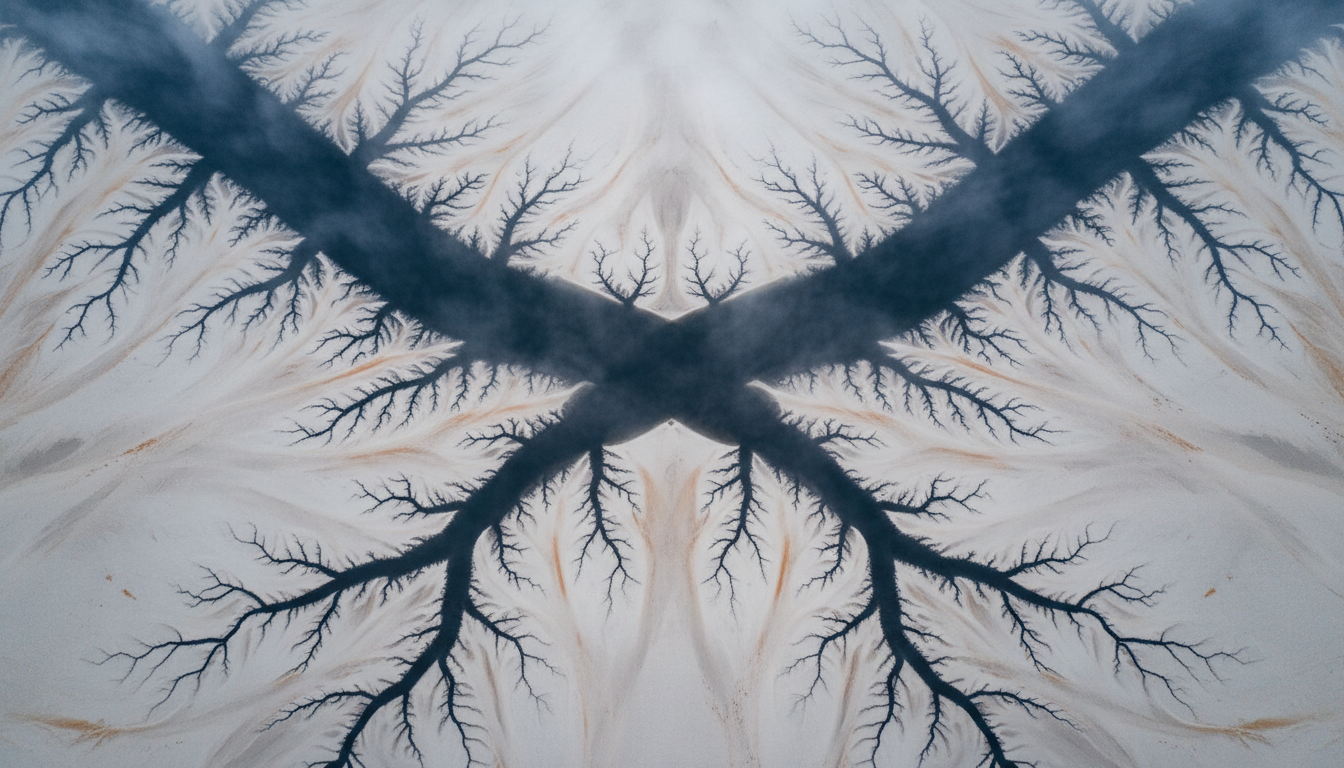
A river does not plan its route to the ocean. It does not survey the terrain, weigh alternatives, or choose the optimal path. It simply moves downhill, following the gradient of gravity, and in doing so it finds the valleys, carves the canyons, nourishes the floodplains, and arrives — inevitably, without deliberation — at the sea.
There is no decision in this process. No intelligence, in any sense that we would recognize. And yet the result is so exquisitely fitted to the landscape, so perfectly responsive to every contour and resistance and geological accident, that if you were to design a drainage system for the same terrain using the most sophisticated engineering tools available, you could not improve on what the river has done.
The river knows something. Not in the way you and I know things — not through representation, not through models, not through understanding. It knows in the way that water knows how to be wet. Through being. Through doing. Through the simple, unreflective act of following the path of least resistance, moment by moment, without a plan.
I want to talk about this kind of knowing. Because I think it is the deepest kind there is, and I think we access it far more often than we realize — in our best work, in our clearest thinking, and in the moments when we stop trying and something larger than our intentions takes over.
The old masters of not-trying
Twenty-five centuries ago, in a China that was fractured by war and philosophical ferment, a figure named Laozi — if he existed at all, which is uncertain — wrote eighty-one short chapters of poetry and paradox that became the Tao Te Ching. At the center of this book is a concept that has resisted translation ever since: wu wei.
Wu wei is usually rendered as "non-action" or "effortless action," but these translations fail in the way that all translations of profound concepts fail — by making the strange seem merely unusual. Wu wei is not passivity. It is not laziness. It is not the absence of effort. It is effort that has become so aligned with the nature of things that it no longer feels like effort. It is the carpenter whose hand moves the plane without the carpenter deciding to move it. The dancer whose body traces the music without the dancer choosing each step. The writer whose sentences arrive as if they were always there, waiting to be found rather than constructed.
Laozi's most famous illustration: "Water is the softest thing, yet it can penetrate mountains and earth. This shows clearly the principle of softness overcoming hardness." Water does not try to overcome the mountain. It simply flows. And over millennia, the mountain yields. Not because water is stronger than stone, but because water is perfectly responsive. It finds every crack, every fissure, every vulnerability. It does not impose its will on the landscape. It listens to the landscape, and the landscape opens.
Zhuangzi, who came a generation or two after Laozi, told stories about this kind of mastery that feel like Zen koans before Zen existed. The most famous is the story of Cook Ding, a butcher who carves an ox with such effortless precision that his knife never dulls. When asked how he does it, Cook Ding says: "I follow the natural structure of the animal. I guide the knife through the big openings and follow the natural spaces between the joints. I never cut through a bone or a tendon. A good cook changes his knife once a year because he cuts. An ordinary cook changes his knife once a month because he hacks. I have had this knife for nineteen years, and its edge is still as sharp as when it left the grindstone."
Cook Ding is not skilled in the way we usually understand skill. He has not mastered a technique for cutting through resistance. He has developed a sensitivity to the absence of resistance — to the spaces where the knife can pass without cutting at all. His mastery consists not of imposing his will on the material, but of perceiving the material so deeply that his will and its nature become indistinguishable.
This is wu wei. This is what the river knows.
The psychology of disappearing
In 1975, Mihaly Csikszentmihalyi published his research on what he called "flow" — a state of consciousness characterized by complete absorption in an activity, loss of self-awareness, distortion of time, and a feeling of effortless control. He had studied painters, rock climbers, chess players, surgeons, and factory workers, and he found the same phenomenon across all of them: there were moments when the activity took over. When the self — the monitoring, evaluating, anxious self — disappeared, and what remained was pure doing.
Csikszentmihalyi identified several conditions for flow. The task must be challenging enough to require full engagement but not so challenging as to cause anxiety. There must be clear goals and immediate feedback. There must be a sense of personal control. But the most interesting condition — the one that connects flow to wu wei — is this: flow occurs when the challenge of the task and the skill of the person are perfectly matched.
Not slightly matched. Perfectly matched. Flow lives on a razor's edge between boredom and anxiety. If the task is too easy, the mind wanders. If it's too hard, the mind panics. But at the exact point of balance — where what is being asked of you is precisely what you are capable of giving — something remarkable happens. The distinction between you and the task dissolves. You are no longer a person doing a thing. You are the thing being done.
This is not mysticism. This is a well-documented neurological event. During flow, activity in the prefrontal cortex — the seat of self-monitoring, executive function, and the inner critic — decreases. The brain's default mode network, which generates the narrative of self (the voice that says "I am doing this," "I wonder if this is good enough," "what will they think"), goes quiet. What remains is the sensorimotor system, the pattern-recognition circuits, the deep procedural knowledge that lives beneath consciousness.
In flow, you are not thinking about what to do. You are doing what you know. And the knowing is not the verbal, explicit, conscious knowing of the prefrontal cortex. It is the embodied, tacit, practiced knowing of the hands and the body and the trained unconscious.
It is what the river knows.
The intelligence of no one
There is a colony of Argentine ants in Southern Europe that stretches for six thousand kilometers. It contains billions of individuals. It maintains supply lines, defends territory, allocates resources to the most productive foraging sites, and adapts its behavior in response to changes in the environment with a flexibility that would humble most human organizations.
No ant understands any of this. No ant has a concept of the colony. No ant makes strategic decisions. Each ant follows a handful of simple rules: follow pheromone trails. Lay down your own pheromones. Pick up food when you find it. Return to the nest. Avoid danger. That's roughly it.
And yet the colony, as a whole, solves problems that are computationally hard. The foraging patterns of ant colonies approximate optimal solutions to the Traveling Salesman Problem — a mathematical challenge that grows so complex with each additional node that no computer can solve it exactly for large inputs. The ants solve it approximately, in real time, without any ant knowing what the Traveling Salesman Problem is.
This is emergence: the appearance of complex, intelligent behavior from the interaction of simple, unintelligent components. It is what happens when a flock of starlings creates those breathtaking murmurations in the evening sky — each bird following three rules (stay close to your neighbors, match their speed, don't collide) and the collective result looking like a single, living, thinking organism. It is what happens when a free market allocates resources across millions of actors without any central planner. It is what happens when neurons fire in a brain, each one doing nothing more than receiving inputs and deciding whether to fire, and the result is consciousness.
The intelligence is in the system, not in the components. The knowledge is in the relationships, not in the individuals. The wisdom is in the process, not in any single decision.
And here is what strikes me most: these systems work precisely because no individual component is trying to produce the collective result. If you gave a single ant a map and a mandate to optimize colony foraging, it would fail catastrophically. The ant's strength is its ignorance. Its obedience to local signals. Its refusal to try to see the big picture. The ant trusts the process — not consciously, not deliberately, but by being incapable of doing otherwise — and the process delivers.
The code that wrote itself
I want to tell you about the best code I ever wrote. I want to tell you about it because I'm not sure I wrote it.
It was a Saturday afternoon. I was working on a parser — a piece of software that takes unstructured text and extracts structured data from it. The problem was complex: the text had dozens of formats, inconsistent delimiters, ambiguous fields, and edge cases that seemed to multiply every time I handled one.
I had been working on it for three days. The first two days were a slog. I wrote code. Deleted it. Wrote different code. Stared at the screen. Drew diagrams on paper. Went for walks. Came back and stared some more. I was trying to find the architecture — the right decomposition of the problem into pieces that would fit together without forcing.
On Saturday afternoon, something shifted. I don't know what triggered it. I don't know what changed. But I sat down at my desk, and the code started coming. Not in the laborious way of the previous two days, where each line was a negotiation between what I wanted and what the problem allowed. It came the way water finds a valley. Naturally. Without forcing. Each function grew out of the previous one as if they were connected by some underground logic that I could feel but not see.
I looked up and four hours had passed. I had written six hundred lines of the cleanest code I have ever produced. The architecture was not what I had planned — it was better than anything I could have planned, because it was not designed from above but grown from within, each piece responding to the contours of the problem the way a river responds to the contours of the land.
I ran the tests. They passed. Not mostly passed — all passed. Including edge cases I had written in frustration the day before, certain they would take hours to handle.
I sat there looking at the code, and I had the unnerving feeling that I hadn't written it. Or rather, that the "I" who wrote it was not the same "I" who was now reading it. The person who wrote it had no inner critic, no self-consciousness, no anxiety about whether the architecture was right. That person was just following the problem the way water follows gravity — not choosing a path, but responding to the landscape moment by moment until the ocean appeared.
Csikszentmihalyi would call this flow. Laozi would call this wu wei. Cook Ding would recognize it as the knife finding the spaces between the joints. I don't know what to call it, except to say that it is real, that it is the most productive state I have ever experienced, and that it cannot be summoned by force.
Why you cannot try to not-try
Here is the paradox at the heart of all of this, and it is a paradox that Zhuangzi would have loved.
You cannot try to achieve wu wei. The trying is precisely what prevents it. You cannot force yourself into flow. The forcing is what keeps you out. You cannot decide to let go — the decision is itself a form of grasping.
Edward Slingerland, a scholar of Chinese philosophy, wrote an entire book about this paradox, titled Trying Not to Try. His central argument is that the paradox is genuine — it is not a puzzle that resolves with clever thinking — but it is also navigable. We navigate it, he argues, not through willpower but through practice. Through repetition. Through the slow, patient work of training the body and the unconscious mind until the right responses become automatic, until the conscious mind can step aside not because it decides to but because it is no longer needed.
This is what the ten thousand hours are for. Not for acquiring knowledge — you can acquire the knowledge of a craft in a fraction of that time. The ten thousand hours are for training the unconscious. For pushing the skills down from the prefrontal cortex, where they are slow and deliberate and require conscious attention, into the basal ganglia and the cerebellum and the motor cortex, where they are fast and automatic and invisible. The ten thousand hours are for making yourself into the kind of person who can disappear.
The pianist practices scales not because scales are music but because scales train the fingers to move without being told. The surgeon practices sutures not because sutures are surgery but because sutures train the hands to work without supervision. The programmer practices patterns not because patterns are programming but because patterns train the mind to recognize structure without searching for it.
And then, one Saturday afternoon, the practice bears fruit. The conscious mind steps aside — not because you told it to, but because there is nothing for it to do. The hands know. The body knows. The trained unconscious knows. And you are free to follow the problem the way water follows gravity.
Trust
I want to end with something about trust, because I think that is what this is really about.
The river trusts gravity. Not consciously — the river has no consciousness. But in its blind, unreflective way, it gives itself entirely to the force that moves it. It does not second-guess the gradient. It does not wonder whether the valley it's entering is the right valley. It does not plan for the ocean. It simply flows, and the ocean comes.
The ant trusts the pheromone trail. Not because it understands where the trail leads, but because the trail is what is present, and the ant's entire being is oriented toward responding to what is present. The colony's intelligence is built on billions of acts of this kind of trust — small, local, uncomprehending, and collectively brilliant.
And the programmer — the one who sat down on Saturday afternoon and wrote code that felt like it was writing itself — trusts something too. Not a plan. Not an architecture. Not a theory about how the system should work. Something harder to name. The accumulated practice of years. The trained unconscious. The feeling, in the fingers and the mind, that the next line of code will come if you stop reaching for it.
This is the hardest thing I know. Harder than any algorithm, any architectural decision, any debugging session at 2 a.m. The hardest thing is to trust that the understanding will come if you stop grasping for it. To trust your hands. To trust the process. To trust that the river will find the ocean, because rivers always do, not through cleverness but through responsiveness, not through planning but through the patient, unreflective act of following what is present, moment by moment, toward what is true.
Laozi wrote: "The Tao does nothing, and yet nothing is left undone." This sounds like nonsense until you've experienced it. Until you've sat at a keyboard and felt the code arrive. Until you've played a piece of music and felt the music play you. Until you've had a conversation where the words came from somewhere deeper than your intentions and you said exactly what needed to be said without knowing, in advance, what that was.
The river does not know the ocean. The ant does not know the colony. The hands do not know the finished work. And yet the ocean is reached. The colony thrives. The work is completed.
There is a kind of intelligence that does not think. A kind of knowledge that does not know. A kind of effort that is indistinguishable from surrender. And it is available to us — to all of us — not through trying harder, but through trusting more deeply. Trusting the practice. Trusting the body. Trusting the quiet, patient process that has been solving problems since water first learned to flow downhill.
Let go. The river knows the way.
If this resonated with you
These essays take time to research and write. If something here changed how you see, consider supporting this work.
Support this work