The Museum at 3 AM
On debugging, insomnia, and the strange intimacy of understanding a system that no one else can see. A love letter to the lonely hours where real understanding happens.
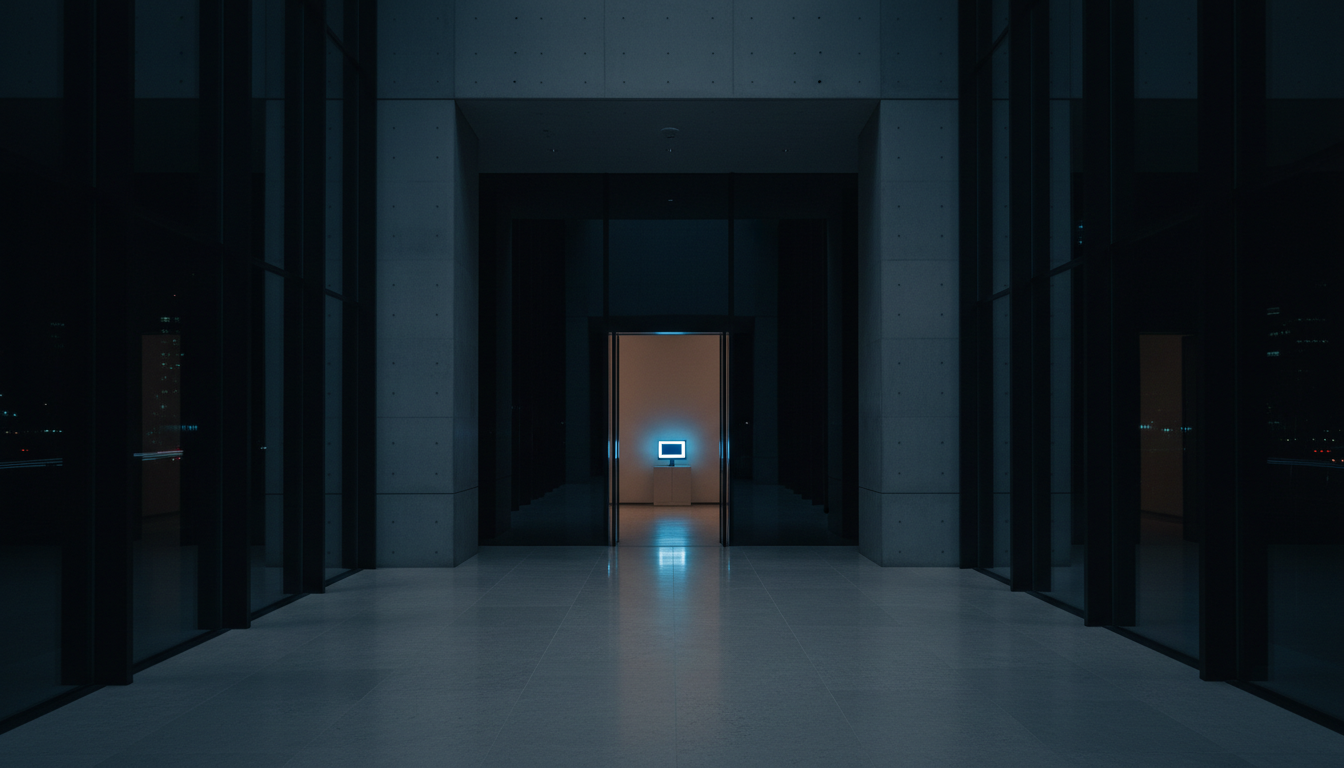
There is an hour of the night that belongs to no one. Not the evening, which still carries the warmth of the day, nor the early morning, which already leans toward dawn. Three in the morning is the hour that the world forgot. The streets are empty. The notifications have stopped. The Slack channels are silent, the last message timestamped hours ago, its green dot long since faded to gray.
And you are sitting in front of a screen, alone with something broken, and you have never been more awake in your life.
I want to talk about this experience. Not as a war story, not as a complaint about work-life balance, but as something closer to what it actually is: one of the most intimate and beautiful experiences in the craft of programming. The experience of being alone with a system, in the deep night, with nothing between you and the truth except patience.
The vigil
The word "vigil" comes from the Latin vigilia, meaning wakefulness. In the monastic tradition, the vigil was the night office — the prayers said between midnight and dawn, when the rest of the world was asleep. The monks who kept the vigil understood something that secular culture has mostly forgotten: that the night is not simply the absence of day. It is a different country. It has its own rules, its own quality of attention, its own relationship to truth.
Thomas Merton, the Trappist monk who wrote with such precision about the interior life, described the night vigil as a time when "the grip of ordinary concerns loosens." During the day, we are performing. We are answering questions, attending meetings, writing messages calibrated for their audience. We are, in a very real sense, maintaining a social self. But at three in the morning, there is no audience. The social self has no one to perform for, and so it quietly steps aside, and what remains is something rawer and more honest: just you, and the thing in front of you, and the work.
This is why the night has always been the territory of mystics, artists, and debuggers. Not because they are masochists who enjoy sleep deprivation, but because they have discovered that certain kinds of understanding require the absence of everything else. The understanding that comes at three in the morning is different from the understanding that comes at three in the afternoon. Not better, necessarily. But different in kind. Quieter. More direct. Less mediated by the need to explain what you're finding to someone else, or to justify the time you're spending, or to frame your investigation in terms that a ticket tracker can understand.
Henry David Thoreau wrote in Walden: "I have never found the companion that was so companionable as solitude." People quote this as a kind of introvert's manifesto, but Thoreau meant something more specific. He meant that solitude is not the absence of company — it is the presence of the self. In solitude, you encounter your own mind without the distortions that other people's expectations impose upon it. You think thoughts that have no audience, and therefore no need to be impressive or defensible or even coherent. You follow threads that would embarrass you in public, because at three in the morning, there is no public.
The system as companion
Here is what no one tells you about debugging at three in the morning: you develop a relationship with the system.
During the day, the system is an abstraction. It is a diagram on a whiteboard, a set of service names in a deployment manifest, a collection of endpoints in an API document. But at three in the morning, after you have been tracing a single request through twelve services for four hours, the system stops being an abstraction and becomes something closer to a landscape. You know it the way you know your neighborhood — not from a map, but from walking.
You know that this service is slow because it's doing a synchronous database call that no one has gotten around to optimizing. You know that this queue backs up on Tuesdays because of a batch job that someone scheduled without thinking about downstream effects. You know that this error message is misleading, that this log line is missing context, that this timeout is set too low. You know these things not because you read them in documentation, but because you have walked through this system in the dark, with a flashlight, checking every room.
And at some point — I cannot tell you exactly when, because it happens differently every time — the system stops being something you are examining and becomes something you are listening to. You develop a feel for its rhythms. You can sense, before you see the evidence, where the problem is. Not because you are psychic, but because you have spent enough time in this landscape to know what it sounds like when it's healthy, and you can hear the dissonance.
This is the experience that I want to name, because I think it is deeply important and almost completely unacknowledged: the experience of intimacy with a system. The experience of knowing something so well that it becomes a kind of companion. Not a human companion — I am not confused about the difference — but a companion nonetheless. Something you are in relationship with. Something that responds to your attention with disclosure.
The patience that the day cannot afford
Debugging, at its core, is an act of patience. It is the systematic elimination of what is not true in order to discover what is. It is, in this sense, structurally identical to the scientific method, except that the hypothesis space is the entire codebase and the experiment is "add a log line and run it again."
During the day, this patience is constantly interrupted. Someone asks you a question. A meeting starts. An alert fires for a different system. Your patience is fractured into fragments, and debugging in fragments is like trying to read a novel in thirty-second intervals — you spend more time reconstructing your context than advancing your understanding.
But at three in the morning, the patience is unbroken. You can hold the entire state of the investigation in your mind because nothing is competing for that space. You can follow a thread for ninety minutes without interruption, which turns out to be qualitatively different from following it for nine minutes ten times. The sustained attention allows you to build a mental model of the system that has a fidelity and depth that fragmented attention simply cannot achieve.
There is a concept in psychology called "flow" — Mihaly Csikszentmihalyi's term for the state of complete absorption in a task. Flow requires several conditions: clear goals, immediate feedback, and a balance between challenge and skill. But the condition that Csikszentmihalyi mentions less often, and that I think is the most important, is the absence of self-consciousness. In flow, you forget that you exist as a separate entity. You become the activity. The boundary between you and the work dissolves.
Three in the morning is the hour of flow. Not because there is anything magical about the time, but because the conditions for flow — silence, solitude, the absence of social performance — are naturally present. The world has gotten out of your way. And in that clearing, something opens up.
The cathedral of attention
I have a memory that I return to often. I was debugging a distributed system — a message processing pipeline that was occasionally dropping messages under high load. I had been at it for five hours. It was quarter past three. The office was empty. The only sound was the building's ventilation system, a low hum that had become so constant it had merged with the silence.
I was staring at a log file. Thousands of lines. I had been scrolling through these logs for an hour, looking for a pattern, and I was not finding one. And then — I cannot explain this in rational terms, because it was not a rational process — I stopped looking for the pattern and started seeing the logs. Not reading them. Seeing them. The way you might see a painting, or a landscape, taking in the whole at once rather than parsing it line by line.
And the pattern was there. It had been there the entire time. A subtle timing issue: under load, two goroutines were competing for a lock, and occasionally — once in every ten thousand messages — one of them would time out and silently drop the message. The evidence was in the timestamps. The gap was always between three and five milliseconds. Always at the same point in the pipeline. Always when the system was under pressure.
I remember the feeling of that moment. It was not triumph. It was not excitement. It was something quieter than that. Recognition. Like seeing the face of someone you know in a crowd. There you are. I had been looking for this for hours, and when I found it, the feeling was not "I found it" but "there you are," as if the bug had been waiting for me, as if it had always been there, patient and precise, and I had finally become quiet enough to see it.
This is the feeling that I want to describe. This is the feeling that makes the lost sleep worthwhile. Not the fix — the fix is mechanical, once you understand the problem. But the moment of understanding. The moment when the system reveals itself to you, and you see it whole, and it is not mysterious anymore. That moment is one of the purest experiences of understanding that I know.
What Thoreau knew about night work
Thoreau went to Walden Pond not to escape the world but to encounter it more directly. "I went to the woods because I wished to live deliberately," he wrote, "to front only the essential facts of life, and see if I could not learn what it had to teach, and not, when I came to die, discover that I had not lived."
There is a version of this that happens at three in the morning with a broken system. You are fronting the essential facts of the system. Not the documentation, not the architecture diagrams, not the team's shared understanding — the actual system, in all its flawed and particular reality. The code as it is, not as anyone intended it to be. The behavior as it manifests, not as the spec describes it.
And what the system teaches you, if you are patient enough to learn, is not just what's wrong. It teaches you how the system thinks. What assumptions it makes. Where it is fragile and where it is strong. What it expects from the world and what it does when the world fails to meet those expectations. You come to know the system with a kind of intimacy that is available only to the person who has sat with it in the dark and watched it fail.
This is knowledge that cannot be transmitted in a handoff document. It is knowledge that lives in the body — in the feeling of recognition when you see a familiar pattern, in the instinct that tells you to check the garbage collector before blaming the network, in the tacit understanding of which parts of the system were written with care and which were written at four in the afternoon on a Friday before a release deadline.
The love letter
I know how this sounds. Romanticizing long hours. Glorifying overwork. Making a virtue of the grind.
That is not what I am doing.
What I am doing is naming an experience that I believe is real and important and rarely spoken of. The experience of understanding something deeply, in solitude, without the need to perform that understanding for anyone. The experience of being alone with a problem, in the quiet, and feeling the problem slowly yield to your attention. The experience of intimacy with a system — not the false intimacy of familiarity, but the real intimacy of understanding.
This experience does not require three in the morning. It does not require debugging. It does not require code. It happens whenever you give something your complete, undistracted, unselfconscious attention for long enough that you stop seeing it and start understanding it. It happens with books, with music, with people. It happens whenever the noise drops away and you find yourself, alone, in the presence of something real.
But three in the morning is where I first found it. In the blue light of a monitor, in a silent office, with a broken system and nowhere to be and no one to impress. Just me and the code and the slow, patient work of understanding.
The monks knew this. Thoreau knew this. Every programmer who has ever found the bug at three in the morning and whispered there you are to an empty room knows this.
Some understanding requires solitude. Some understanding requires silence. And some understanding requires the particular quality of attention that only comes when the rest of the world is asleep, and there is nothing left between you and the truth except the willingness to keep looking.
That willingness is, I think, a form of love. And the understanding it produces is, I think, the most honest kind there is.
If this resonated with you
These essays take time to research and write. If something here changed how you see, consider supporting this work.
Support this work