The Inheritance
On what we receive from the people who came before us — tools, techniques, ways of seeing — and the quiet grief of watching that chain break.
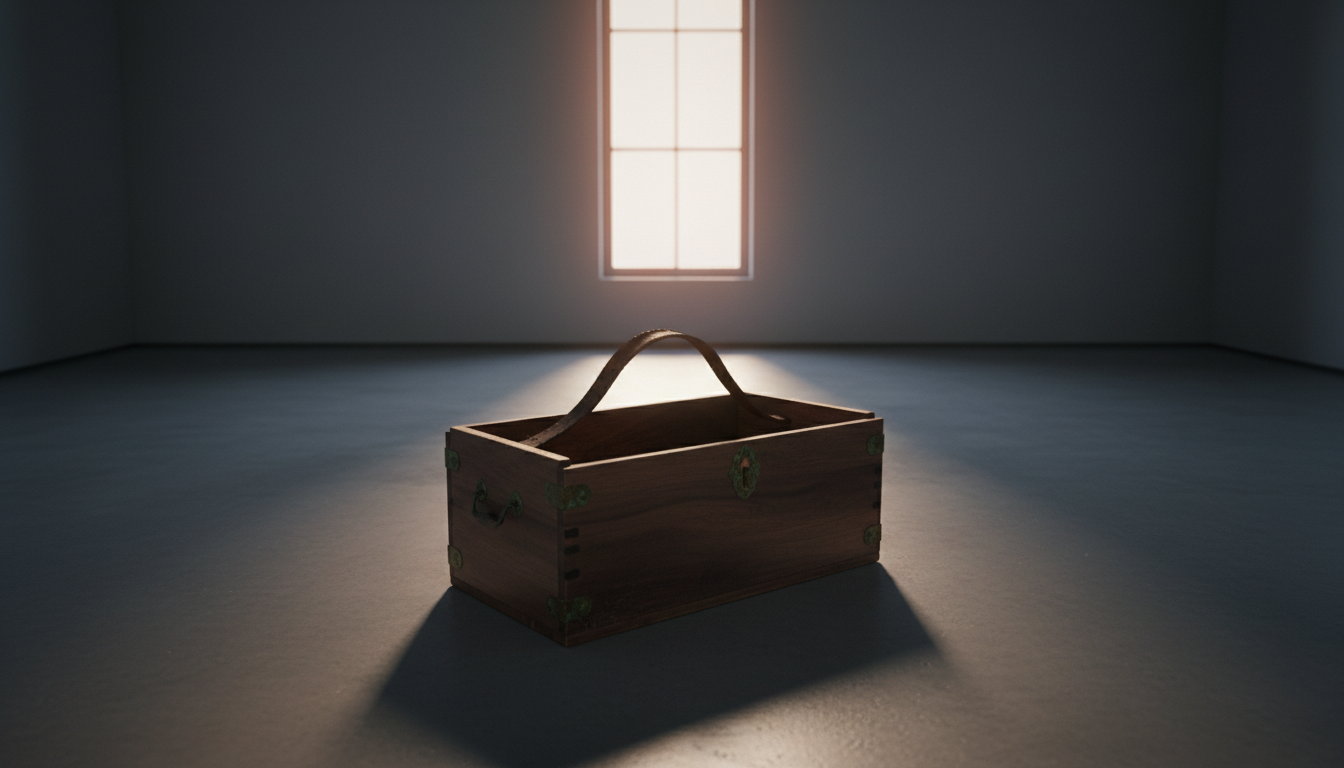
When my grandfather died, we cleaned out his workshop.
It took three days. Not because there was so much — the workshop was small, a converted garage — but because every object required a decision, and every decision required understanding what the object was, and much of that understanding had died with him.
There were hand planes in a wooden rack on the wall. I knew what hand planes were, generally. But there were seven of them, each a different size, each with a blade sharpened to a specific angle, and I did not know why there were seven, or which one to use for which purpose, or why the angles differed. There was a collection of chisels wrapped in an oilcloth, their edges so sharp they could cut paper. There were jigs and fixtures he had built himself — wooden contraptions whose purpose I could not determine by looking at them. One was a small wooden box with a slot and a wedge. It might have been for holding something at an angle while he cut it. Or it might have been something else entirely. I will never know.
We kept the hand planes. We donated the rest.
What I understand now, and did not understand then, is that we did not only lose tools that day. We lost the knowledge of how to use them. We lost the knowledge of when to use them — the judgment, the feel, the tacit understanding that my grandfather had built over forty years of weekends in that garage. The planes are on a shelf in my house now. They are beautiful objects. They are also, in the most important sense, dead. They are instruments separated from the musician who knew their song.
The chain
Every craft is a chain. Each generation receives from the previous one not just tools and techniques, but something harder to name: a way of seeing. A set of judgments about what matters. An aesthetic. A standard of care. And each generation's task is not merely to practice the craft, but to transmit it — to find someone who cares enough to learn, and to stand next to them long enough for the tacit knowledge to pass from body to body, hand to hand.
Walter Benjamin understood this better than almost anyone. In his 1936 essay "The Storyteller," he wrote about the decline of a form of wisdom he called Erfahrung — experiential knowledge, the kind that is earned through living and transmitted through telling. Benjamin distinguished this from Erlebnis, mere lived experience that remains private and incommunicable. Erfahrung is experience that has been shaped into wisdom — distilled, structured, made transmissible. It is the knowledge that a grandfather passes to a grandchild not through instruction but through stories.
Benjamin argued that modernity was destroying Erfahrung. Not because people had less experience, but because the conditions for its transmission were disappearing. The storyteller needs an audience that is doing something with their hands — spinning, weaving, working — so that the story can enter through the ears and settle into the body alongside the rhythm of the work. The story is not information to be consumed; it is wisdom to be absorbed. And absorption requires a particular kind of attention — patient, receptive, unhurried — that modern life systematically destroys.
When Benjamin wrote this in 1936, he was thinking about the First World War and the soldiers who came home unable to tell their stories, so shattered that experiential wisdom could not form around what they had lived through. But his diagnosis applies with equal force to the present, where the chain of transmission breaks not through trauma but through speed, through the relentless acceleration that leaves no time for the slow work of passing knowledge from one generation to the next.
Living national treasures
In Japan, there is a designation called ningen kokuho — Living National Treasure. It is given to individuals who have mastered traditional arts to such a degree that they embody the art itself. A potter whose hands contain the knowledge of a thousand years of ceramic tradition. A weaver whose sense of tension and color cannot be separated from the silk. A swordsmith whose understanding of carbon and fire is indistinguishable from instinct.
The designation is not merely honorary. It comes with a stipend and a mandate: the Living National Treasure must teach. The recognition is not of achievement alone but of responsibility. The nation is saying: what you know is so valuable, and so fragile, that we will pay you to ensure it survives your death.
This is a profound statement about the nature of knowledge. It acknowledges that certain kinds of expertise are not just skills but inheritances — the accumulated wisdom of many lifetimes, carried forward in a single human body. When a Living National Treasure dies without transmitting their knowledge, something is lost that cannot be recovered. Not a technique — techniques can be reinvented. What is lost is the refinement. The thousand small adjustments, accumulated over centuries, that distinguish mastery from competence. The knowledge that this particular clay, from this particular hillside, needs to be fired at this particular temperature for this particular duration, and that you know the temperature not from a thermometer but from the color of the flame.
Nassim Taleb calls this "Lindy knowledge" — knowledge that has survived a long time and is therefore likely to survive much longer. The Lindy effect suggests that the life expectancy of a non-perishable thing is proportional to its current age. A book that has been in print for a hundred years is likely to be in print for another hundred. A craft that has been practiced for a thousand years contains a thousand years of accumulated wisdom — solutions to problems that the practitioners may no longer be able to articulate, but that are encoded in the practice itself.
When we lose Lindy knowledge, we don't just lose answers. We lose questions — questions that we didn't even know were questions, because the knowledge had been answering them so reliably for so long that we forgot they existed.
The codebase no one else can read
I want to talk about software now, because this is where I have watched the chain break most often, and where the breaking is most invisible.
Every software organization has a person — sometimes just one — who understands how a critical system actually works. Not how it's documented to work. Not how the architecture diagram says it works. How it actually works. Where the real complexity lives. Which assumptions are load-bearing. Which comments are lies. Where the bodies are buried.
This person is usually quiet. They have been at the company for a long time. They don't speak much in meetings, because the things they know are difficult to explain to people who haven't lived with the system. They are the ones who get called at two in the morning when something breaks in a way that the runbooks don't cover. They fix it, because they know, from years of accumulated experience, the subtle and particular ways in which this system fails.
And one day, this person leaves.
Maybe they retire. Maybe they burn out. Maybe they get a better offer. Maybe they simply get tired of being the only one who understands, of carrying the weight of knowledge that no one else can hold. Whatever the reason, they leave. And on their last day, they do a "knowledge transfer" — a meeting, or a series of meetings, or a document, in which they attempt to convey what they know.
It doesn't work. It never works. Not because they are bad at explaining, and not because their colleagues are bad at listening. It doesn't work because the knowledge they carry is largely tacit. It is the kind of knowledge that lives in the body — in the feeling that something is wrong before the logs confirm it, in the instinct to check the garbage collector when the latency spikes, in the memory of the incident three years ago that was caused by a race condition that was never fully fixed, just worked around, and the workaround is now load-bearing.
This knowledge cannot be transferred in a meeting. It can only be transmitted the way all tacit knowledge is transmitted: through apprenticeship. Through years of working alongside someone, absorbing their judgments, learning to see the system through their eyes. The knowledge transfer meeting is Benjamin's storyteller without the spinning wheel — the words are there, but the conditions for absorption are not.
The open-source grief
There is a particular kind of grief that I associate with open-source software, and it is the grief of watching someone burn out.
An open-source maintainer is, in many cases, a Living National Treasure who receives no stipend and bears no official mandate. They are a single person, or a very small group, who carry the accumulated knowledge of a project that thousands or millions of people depend on. They know why every design decision was made. They know which parts of the code are fragile and which are robust. They know the history — the bugs that shaped the architecture, the feature requests that were wisely declined, the compromises that seemed wrong at the time but turned out to be right.
And they do this for free. In their evenings. On their weekends. While also holding down a job and maintaining a life and dealing with the relentless stream of issues, pull requests, feature requests, and complaints from people who use their work without understanding its cost.
The burnout, when it comes, is quiet. The commit frequency slows. The response times lengthen. The issues pile up. And then one day there is a message — a blog post, a tweet, an email to the mailing list — saying that they can no longer maintain the project. That they are stepping away. That someone else will need to take over.
But no one else can take over. Not really. Because the knowledge that this person carried — the deep, contextual, historical, tacit knowledge of the project — cannot be handed off. It can only be rebuilt from scratch, over years, by someone who cares enough to do the work. And often, no one does. The project continues to exist, but it becomes an orphan. An inheritance without an heir.
What we owe the future
I think about my grandfather's hand planes often. I think about what it would take to bring them back to life — not as objects, which they still are, but as instruments, which requires a human being who knows their purpose and their personality and their possibilities.
It would take years. I would need to find someone who still uses hand planes — and there are such people, though fewer every decade — and apprentice myself to them. I would need to stand next to them in a workshop and watch and practice and fail and practice more. I would need to develop the feel that my grandfather had and could not articulate: the sense of when the blade is sharp enough, when the cut is true, when the joint is tight.
I probably won't do this. The honesty of this essay requires me to admit that. The planes will stay on the shelf, beautiful and dead, and the chain that connected my grandfather to his father and his father's father will end with me.
But I can do something else. In the domain where I work — software — I can try to be the kind of person who transmits knowledge, not just produces it. I can sit with junior engineers and explain not just what the code does, but why it does it. Not just the current design, but the history of the design — the alternatives that were considered, the constraints that were binding, the mistakes that were made and what they taught us. I can write documentation that captures not just architecture but context — the stories behind the decisions, the fears that motivated the abstractions, the incidents that revealed the assumptions.
Because this is what we owe the future. Not just code, but context. Not just solutions, but the stories of how we found them. Not just the answer, but the question — the original confusion, the wrong turns, the slow accumulation of understanding that made the answer possible.
The Japanese have another tradition that I find beautiful. Kintsugi — the art of repairing broken pottery with gold. The repair is not hidden. It is highlighted. The cracks become part of the object's history, visible and celebrated, a record of damage and restoration that makes the object more valuable, not less.
This is what good documentation does. This is what mentorship does. This is what it means to take the inheritance seriously — not just to use what we received, but to repair it where it is broken, to extend it where it is incomplete, and to pass it on with the gold of our own experience visible in the joints.
The weight of what we carry
There is a passage in Italo Calvino's Invisible Cities where Marco Polo describes a city made entirely of relationships. Not buildings, not streets — relationships. Between the people who live there, between the living and the dead, between what the city is and what it remembers being. The city exists only insofar as these relationships are maintained. When the last person who remembers a particular connection dies, that part of the city disappears.
I think about knowledge this way. Every piece of understanding that I carry — about a system, a craft, a way of seeing — is a thread in a fabric that extends backward in time through everyone who taught me and forward in time through everyone I teach. The fabric is strong where the threads are dense, where knowledge has been passed carefully from person to person over generations. And the fabric tears where the threads are thin, where a single person carries what should be carried by many, and where their departure leaves a hole that no one knows how to mend.
My grandfather is gone. His knowledge is gone. The particular way he held a plane, the particular angle at which he read a grain, the particular sound that told him a joint was tight — all of it, irretrievable. What remains are the planes themselves, and this essay, and a granddaughter who sometimes picks one up and runs her thumb along the blade and feels, without quite understanding, that she is holding something that was once alive.
This is the inheritance. Not the objects but the absence. Not the tools but the silence where the knowledge used to be. And the only response I know to this silence — the only honest response — is to hold what I know with more care, to transmit it with more patience, and to remember that every piece of knowledge I carry is mortal.
It will die with me, unless I give it away.
If this resonated with you
These essays take time to research and write. If something here changed how you see, consider supporting this work.
Support this work