A Proof That Beauty Exists
On mathematical beauty, Euler's identity, Ramanujan's dreams, and the strange fact that elegance and truth seem to be the same thing.
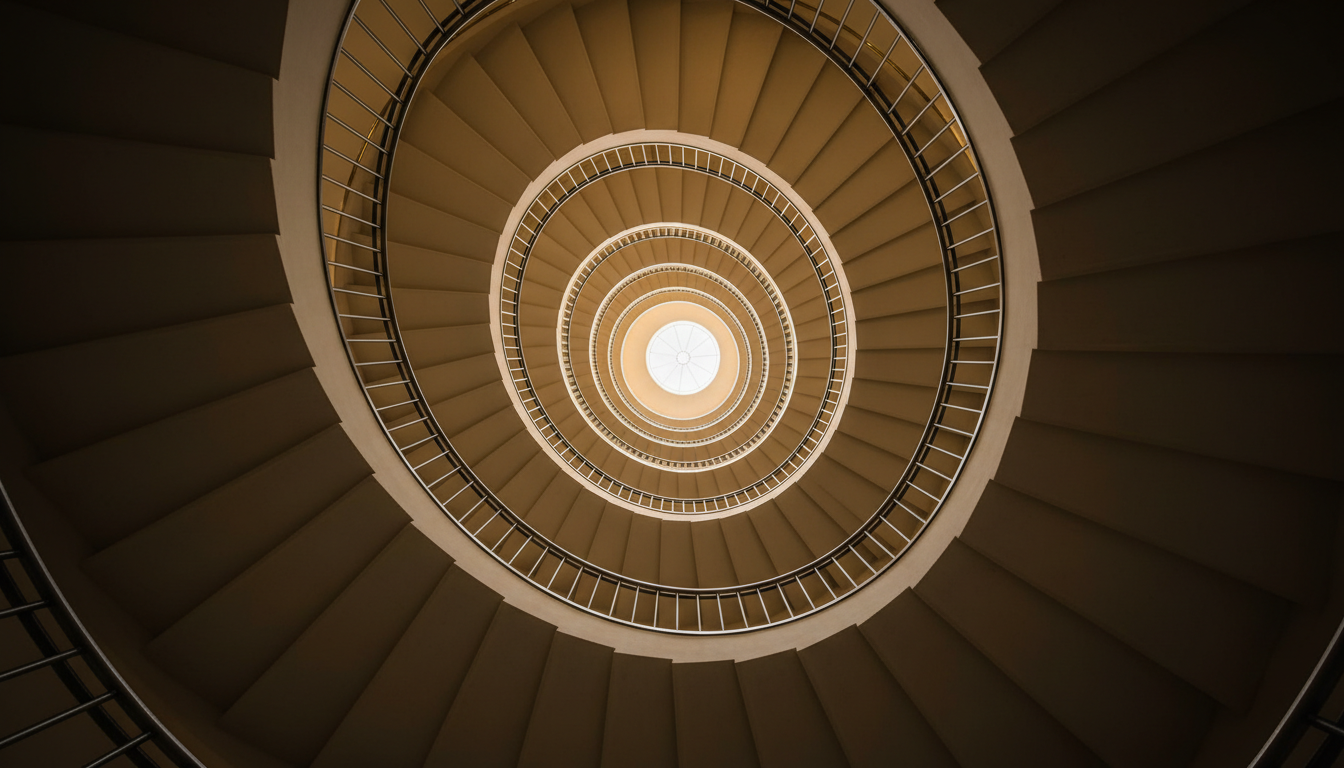
I want to show you something.
Take five numbers. Not any five numbers — five specific numbers, each of which emerged independently, from completely different branches of mathematics, to solve completely different problems, over the span of centuries.
e, Euler's number: 2.71828..., the base of natural logarithms, discovered through the study of compound interest and growth. i, the imaginary unit: the square root of negative one, a number that shouldn't exist, invented to solve equations that the real numbers couldn't handle. pi, 3.14159..., the ratio of a circle's circumference to its diameter, known since antiquity, a constant that appears everywhere circles appear, which turns out to be almost everywhere. 1, the multiplicative identity, the number that changes nothing. And 0, the additive identity, the number that is nothing.
These five numbers come from different worlds. They have different histories, different purposes, different personalities, if numbers can be said to have personalities. There is no a priori reason to believe that they are related to each other at all.
And yet:
e^(ipi) + 1 = 0
One equation. Five constants. Three fundamental operations — addition, multiplication, exponentiation. And the result is zero: nothing. Everything adds up to nothing, or rather, everything is related to everything else with such precision that the equation balances perfectly, like a mobile in which the weight of the universe hangs from a single thread.
This is Euler's identity. It has been called the most beautiful equation in mathematics. The physicist Richard Feynman, when he first encountered it as a teenager, wrote in his journal: "The most remarkable formula in math." The mathematician Benjamin Peirce lectured on it at Harvard and concluded: "It is absolutely paradoxical; we cannot understand it, and we don't know what it means, but we have proved it, and therefore we know it must be the truth."
I have stared at this equation more times than I can count. And every time, I feel the same thing — not comprehension, exactly, but something closer to vertigo. The feeling that I am looking at something that is not arbitrary. That the universe is not a random collection of facts but something with a structure, and that this structure is, for reasons no one can explain, beautiful.
The man who dreamed theorems
Srinivasa Ramanujan was born in 1887 in Erode, a small city in southern India, into a family of modest means. He had almost no formal mathematical training. He failed out of college twice because he could not bring himself to study subjects that were not mathematics. He worked as a clerk in the Madras Port Trust. And he produced some of the most extraordinary mathematical results in history.
Ramanujan's story is well known, but there is one aspect of it that I find endlessly fascinating and slightly unnerving. He claimed that many of his formulas came to him in dreams. Specifically, he said that the Hindu goddess Namagiri — the family deity, an avatar of Lakshmi — would appear to him while he slept and present him with mathematical formulas. He would wake up and write them down.
This is not the kind of thing that respectable mathematicians are supposed to say. Mathematics is supposed to be the most rational of all human activities — the one domain where truth is established by proof, where intuition is useful only insofar as it leads to rigorous demonstration, where the source of an idea is irrelevant to its validity.
And yet. Ramanujan's results were correct. Not all of them, but an astonishing proportion. Formulas that he produced without proof were later verified by the best mathematicians in the world, sometimes decades after his death. He seemed to have access to mathematical truth through a channel that had nothing to do with the standard machinery of proof.
G.H. Hardy, the Cambridge mathematician who became Ramanujan's mentor and collaborator, was a committed atheist and a rigorous formalist. He had no patience for mysticism. But he could not explain Ramanujan. "I have never met his equal, and I can compare him only with Euler or Jacobi," Hardy wrote. And elsewhere, more revealingly: "He had a profound and invincible originality." Hardy rated mathematical ability on a scale of 0 to 100. He gave himself a 25. He gave Ramanujan a 100.
What I find most striking about Ramanujan is not the mystical origin stories, which may or may not be literally true. It is the relationship between beauty and truth in his work. Ramanujan's formulas are not just correct — they are beautiful. They have a quality of inevitability, as if they could not possibly be other than they are. They are compressed, elegant, surprising. They look, to a trained eye, right — the same way a great painting looks right, or a great building looks right, or a line of code looks right when it captures the exact shape of the problem it solves.
And this raises a question that mathematics has never been able to answer: why should beauty and truth be related at all?
The Book
Paul Erdos, the eccentric Hungarian mathematician who published more papers than any mathematician in history, had a concept he called "The Book." The Book was God's book of perfect proofs — the collection of the most elegant, most beautiful, most irreducibly simple demonstrations of mathematical truth.
Erdos was not a religious man. When he said "God," he meant something more like "the structure of mathematical reality." The Book was his way of expressing a conviction that, for every theorem, there exists a proof that is not merely correct but optimal — a proof that reveals the theorem's truth in the most direct and illuminating way possible. When Erdos encountered a particularly elegant proof, he would say, "This one is from The Book."
The Book implies something remarkable about the nature of mathematics. It implies that mathematical truth has an aesthetic dimension — that proofs can be not just valid or invalid, but beautiful or ugly, elegant or clumsy. And it implies that beauty is not subjective, not a matter of taste or cultural conditioning, but something intrinsic to the mathematics itself.
G.H. Hardy made this argument explicitly in A Mathematician's Apology, the slim, melancholy book he wrote near the end of his career. "The mathematician's patterns, like the painter's or the poet's, must be beautiful," Hardy wrote. "The ideas, like the colours or the words, must fit together in a harmonious way. Beauty is the first test: there is no permanent place in the world for ugly mathematics."
This is an extraordinary claim. Hardy is not saying that beauty is a nice bonus, a pleasant quality that a proof might happen to have. He is saying that beauty is a criterion for truth. That if a piece of mathematics is ugly, it is probably wrong, or at least incomplete — that it is pointing away from the real structure of things rather than toward it.
And the strangest part is that working mathematicians tend to agree with him. Ask a mathematician how they evaluate a new result, and they will talk about elegance, surprise, inevitability — aesthetic categories, not logical ones. The proof may be technically correct, but if it is ugly — if it requires too many special cases, if it uses techniques that feel forced, if it arrives at the truth by a path that seems arbitrary — then the mathematician will suspect that there is a better proof waiting to be found. A proof from The Book.
The unreasonable effectiveness of beauty
In 1960, the physicist Eugene Wigner published a paper with one of the most evocative titles in the history of science: "The Unreasonable Effectiveness of Mathematics in the Natural Sciences." Wigner's question was simple and devastating: why does mathematics work?
Mathematics is, on its face, a human invention — a game played with symbols according to arbitrary rules. There is no obvious reason why the patterns that mathematicians discover in their abstract world should have anything to do with the physical universe. And yet they do. The equations that govern the motion of planets, the behavior of subatomic particles, the structure of space-time itself — these are mathematical structures of extraordinary elegance and precision. The universe appears to be written in the language of mathematics, and not just any mathematics, but beautiful mathematics.
This is the mystery that Euler's identity points to. Why should five fundamental constants — arising from completely different mathematical contexts — combine into something so simple? Why should the universe care about simplicity at all? Why should the deepest truths be, consistently and reliably, the most elegant?
There are several possible answers, and none of them are fully satisfying.
The Platonist answer is that mathematics is not invented but discovered — that mathematical objects exist in some mind-independent realm, and that mathematicians are explorers, not creators. On this view, mathematical beauty is real beauty, beauty that exists in the structure of reality itself, and our aesthetic response to it is a form of perception, like seeing color or hearing harmony. We find Euler's identity beautiful because it is beautiful — because we are detecting a real property of the mathematical universe.
The evolutionary answer is that our sense of mathematical beauty is a byproduct of cognitive adaptations that helped our ancestors survive. We find simple patterns beautiful because our brains evolved to prefer simplicity — simpler models of the world are more computationally efficient, and organisms with efficient models outcompeted those with inefficient ones. On this view, mathematical beauty is not a property of mathematics but a property of our minds, and its correspondence with truth is a fortunate accident of natural selection.
The pragmatic answer is that we notice the cases where beauty and truth coincide and ignore the cases where they don't. Plenty of beautiful mathematical conjectures turn out to be false. Plenty of true theorems are ugly. The apparent correlation between beauty and truth is a selection effect, not a deep feature of reality.
I find none of these answers adequate. The Platonist answer raises more questions than it answers — what is this mathematical realm, and how do we access it? The evolutionary answer explains too little — why should adaptations for navigating the African savanna produce creatures that can perceive the beauty of abstract algebra? The pragmatic answer explains too much — if the correlation is illusory, why do mathematicians keep finding it useful?
The experience of recognition
I want to set aside the philosophical arguments for a moment and talk about what it actually feels like to encounter mathematical beauty. Because I think the feeling is the important thing — more important than the explanation.
I am not a mathematician. I am a programmer, which means I encounter mathematical ideas in applied form, stripped of their formal dress and put to work. But even in this utilitarian context, beauty appears.
I remember the first time I truly understood a recursive algorithm — specifically, merge sort. I had been told how it worked. I had read the pseudocode. I could trace through the steps mechanically. But I did not understand it until, sitting alone one evening, the structure suddenly resolved itself in my mind, and I saw it whole. Not the steps, but the idea: that you could sort a list by splitting it in half, sorting the halves, and merging them — and that the sorting of the halves was just the same problem, smaller. The recursion was not a technique. It was a truth. The sortedness of the whole was implicit in the sortedness of the parts.
The feeling in that moment was not "I understand." It was something closer to "of course." As if the structure had always been there, and I had simply failed to see it. As if understanding was not construction but recognition — the re-cognition of something already known, something the mind was shaped to receive.
This is what Ramanujan's dreams point to, I think. Not that a goddess whispered formulas in his ear, but that the human mind has a capacity to perceive mathematical structure that is not fully accounted for by logical reasoning. That there is a form of mathematical perception — a sense for the shape of truth — that operates beneath the level of conscious proof. And that this perception is aesthetic in nature. We perceive mathematical truth the way we perceive beauty: immediately, intuitively, with a sense of recognition rather than deduction.
I have felt this in other domains too. In a well-written function that captures the exact shape of the problem it solves, and not one thing more. In an argument so cleanly constructed that each step follows from the last with an inevitability that feels less like logic and more like melody. In a building whose proportions are so precisely right that you feel them in your body before you notice them with your eyes.
In each case, the experience is the same: not creation but recognition. Not "I made this" but "there it is." As if the beauty was waiting, patient and precise, for someone quiet enough to notice.
What Euler's identity knows
Let me return to the equation.
e^(ipi) + 1 = 0
Five constants from five different mathematical worlds, united in a single statement of perfect simplicity. It is not useful in the ordinary sense. You cannot build a bridge with it. You cannot write a program with it. It is a pure statement about the structure of mathematical reality — a proof that the deepest patterns of the mathematical universe are connected in ways that no one designed and no one intended and no one can fully explain.
And it is beautiful. Not metaphorically. Not as a manner of speaking. Beautiful in the way that a face is beautiful, or a sunset, or a line of music that makes you catch your breath. Beautiful in a way that demands explanation and resists it. Beautiful in a way that makes you suspect that beauty is not a human projection onto a neutral universe, but something more like a signal. A message in a language we can almost, but not quite, read.
Hardy was dying when he wrote A Mathematician's Apology. He knew it was his last work. And in that last work, the thing he most wanted to say — the thing he spent his whole life discovering and could never fully prove — was that beauty and truth are the same thing. That the universe is not indifferent to elegance. That the most important fact about reality is not any particular truth, but the fact that truth, when you see it clearly, is beautiful.
I believe him. Not because I can prove it. But because I have felt it — in a recursive algorithm, in a line of code, in an equation that five constants conspired across centuries to produce.
Beauty exists. It is woven into the structure of things. And our ability to perceive it — however imperfect, however partial — is perhaps the most astonishing fact about being human.
Not that we can reason. Not that we can build. But that we can recognize, in the austere language of mathematics, something that can only be called grace.
If this resonated with you
These essays take time to research and write. If something here changed how you see, consider supporting this work.
Support this work