The Carpenter's Theorem
There is a kind of knowledge that lives in the hands and refuses to be spoken. On tacit knowledge, Wittgenstein's ladder, and why the most important things we know are the things we cannot say.
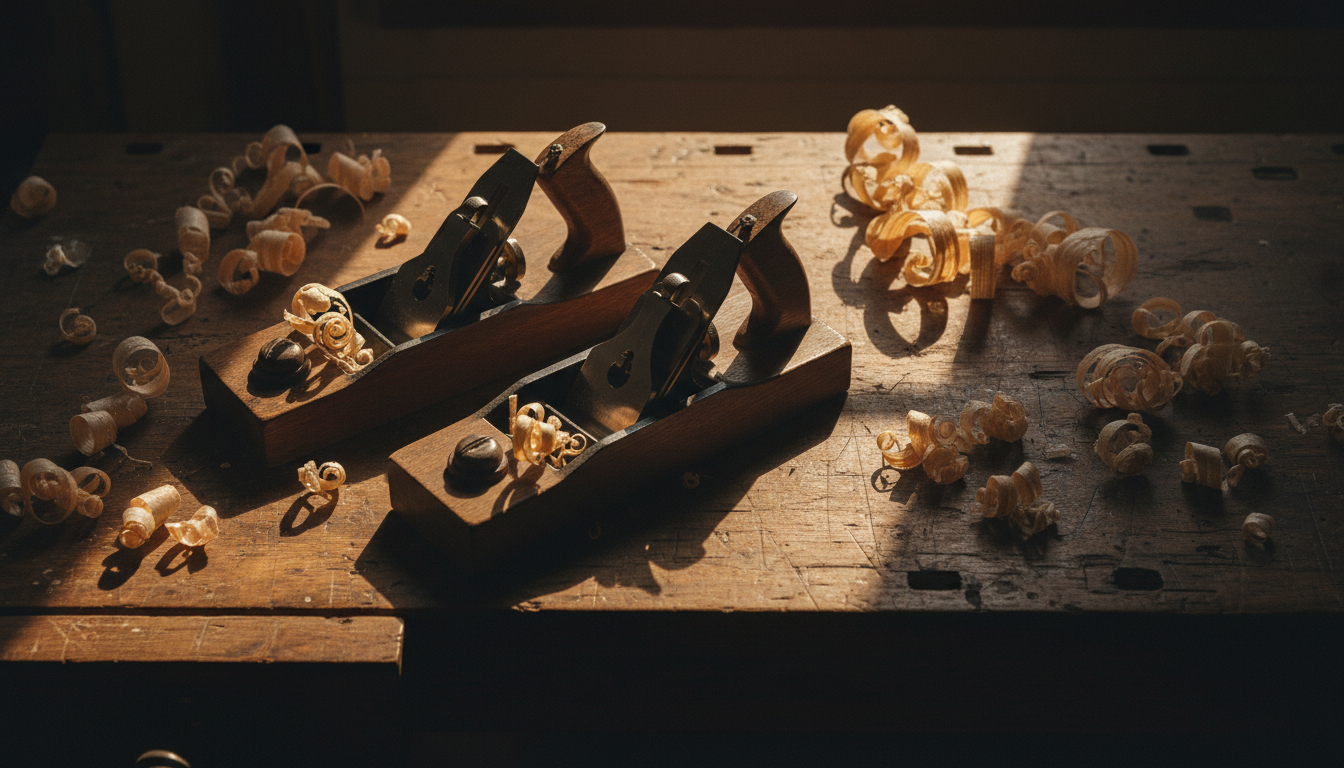
My grandfather built furniture. Not as a profession — he was an accountant — but in his workshop on weekends, with hand tools he'd inherited from his father. He built chairs, tables, bookshelves. They were simple and sturdy and, in a way I didn't appreciate until he was gone, beautiful.
I once asked him how he knew when a joint was tight enough. He looked at his hands as if the answer were written on them, and then he said something I've thought about almost every day since: "You feel it stop."
He couldn't tell me more than that. Not because he was being evasive, but because the knowledge lived in his hands, not in his words. He knew the difference between a joint that was tight and a joint that was overtight with a precision that no measuring instrument could match. But the knowledge was of a kind that language couldn't carry.
This is the oldest and most important kind of knowledge there is. And we are losing the ability to even recognize it exists.
The philosopher who tried to say the unsayable
Ludwig Wittgenstein spent his life wrestling with the boundary between what can be said and what can only be shown. His first major work, the Tractatus Logico-Philosophicus, ends with one of the most famous sentences in philosophy: "Whereof one cannot speak, thereof one must be silent."
This is usually interpreted as a statement about the limits of language — a warning to stop talking about things we can't articulate. But Wittgenstein meant something much more radical. He wasn't saying that the unsayable doesn't matter. He was saying that the unsayable is all that matters.
The things we can say — logical propositions, factual statements, scientific theories — are, for Wittgenstein, the easy part. They are the scaffolding. The things that matter — ethics, aesthetics, the meaning of life, the experience of beauty — cannot be captured in propositions. They can only be shown. Experienced. Felt.
And here is the part that makes most people uncomfortable: Wittgenstein said the same thing about his own book. The Tractatus ends with a metaphor that is almost unbelievably bold for a work of philosophy: "My propositions serve as elucidations in the following way: anyone who understands me eventually recognizes them as nonsensical, when he has used them — as steps — to climb beyond them. He must, so to speak, throw away the ladder after he has climbed up it."
The book asks you to read it, understand it, and then discard it. Because the understanding is not in the words. The understanding is what happens to you when the words have done their work and fallen away.
My grandfather's hands knew something that his words could not carry. Wittgenstein's philosophy knew something that his propositions could not carry. These are not failures of articulation. They are encounters with a kind of knowledge that is, by its nature, beyond articulation.
What Michael Polanyi found in the laboratory
The Hungarian-British scientist Michael Polanyi spent decades studying how scientists actually make discoveries, as opposed to how the textbooks say they make discoveries. And what he found was that the official story — hypothesis, experiment, data, conclusion — was a fiction. A useful fiction, but a fiction nonetheless.
Real discovery, Polanyi argued, begins with something he called "tacit knowledge" — a kind of knowing that the knower cannot fully articulate. A chemist develops a "feel" for which reactions will work. A diagnostician looks at a patient and senses something wrong before the tests confirm it. A physicist reads an equation and knows, without being able to explain how, that it's pointing toward something true.
Polanyi's most famous formulation: "We know more than we can tell."
This sounds like a platitude until you sit with it. Think about riding a bicycle. You know how to do it. You can do it effortlessly, in traffic, while carrying groceries, while having a conversation. But you cannot explain how you do it. Not really. You might say something about balance and momentum and leaning into turns, but if someone followed your instructions exactly, they would fall over. The knowledge that keeps you upright is not in the instructions. It is in your body. It is tacit.
Polanyi argued that this isn't a deficiency of bicycle-riding as a form of knowledge. It's a feature of all knowledge. Every act of knowing, he said, has a tacit component — a foundation of things we rely on but cannot articulate. Even the most explicit, formal, propositional knowledge (a mathematical proof, a scientific theory) rests on a substrate of tacit understanding that the knower cannot fully surface.
The implications of this are staggering. It means that the most important parts of what we know are precisely the parts we cannot teach through words. That the real knowledge in any field — the knowledge that distinguishes the master from the competent — cannot be written in a textbook or coded into an algorithm. It can only be transmitted through apprenticeship, through practice, through the slow accumulation of experience that rewires the body and the unconscious mind.
The craft of debugging
I want to tell you about a moment that changed how I think about programming.
I was three years into my career, working on a system that processed financial transactions. We had a bug — a subtle one. Under certain conditions, transactions would be duplicated. Not always. Not predictably. Just often enough to matter.
I spent two days reading code, adding logging, constructing theories. Nothing worked. Every theory I formed was disproved by the next data point. The bug was like smoke — visible but impossible to grasp.
On the third day, a senior engineer named Maria sat down next to me. She didn't ask me to explain the bug. She didn't look at my logs. She just asked me to show her the code. I started scrolling through files, narrating the flow of a transaction through the system.
About twenty minutes in, she said, "Go back."
I scrolled up.
"There," she said, pointing at a function that I had read at least fifty times. "It's re-entrant."
She was right. The function could be called while it was still executing from a previous call, and under specific timing conditions, this would cause the duplication. I had read the function dozens of times, but I had never seen it. Because I was reading it as isolated code — a static text. Maria was reading it as a living process — a dynamic system with timing and state and the possibility of concurrent execution.
How did she know? I asked her. She paused. "I'm not sure," she said. "Something about the shape of it." And then, almost apologetically: "I've seen that shape before."
That is tacit knowledge. That is the carpenter feeling the joint stop. That is the thing that no amount of documentation or training or explanation can transmit. It can only be developed through years of practice, through thousands of bugs found and fixed, through the slow accretion of pattern recognition that eventually becomes something we can only call intuition.
Why we can't automate wisdom
There is a growing anxiety in the technology industry about whether artificial intelligence will replace programmers. And the answer depends entirely on what you think programming is.
If programming is the translation of explicit specifications into code — if it's a matter of knowing syntax, algorithms, and patterns — then yes, much of it can be automated. A language model can write a sort function. It can implement a REST API. It can follow a recipe.
But if programming is what Maria did in that moment — the recognition of a "shape" in code that signals danger, the intuitive grasp of how a system will behave under conditions that the code itself doesn't make explicit — then no. Because that knowledge is tacit. It doesn't exist in any corpus. It wasn't written down anywhere for a model to train on. It lives in the bodies and unconscious minds of people who have spent years debugging systems, and it manifests as a feeling. A sense. A wordless recognition.
This is not mysticism. This is the most practical kind of knowledge there is. And it is the kind of knowledge that we are in the greatest danger of losing, because our culture has come to believe that if something cannot be made explicit — if it cannot be written in a document, measured by a metric, or captured in a dataset — then it doesn't really exist.
Polanyi warned about exactly this. He saw that the modern obsession with explicit knowledge — with information, data, formalization — was creating a blind spot. We were getting better and better at capturing what can be said, and forgetting that most of what matters is what cannot.
The ladder and the practice
Here is what I've come to believe.
There are two kinds of learning. The first is the kind we're good at: reading books, watching tutorials, following instructions. This is explicit learning, and it is indispensable. You cannot build a house without knowing the properties of wood. You cannot write code without knowing a programming language. You cannot do science without knowing mathematics.
But there is a second kind of learning that begins where the first one ends. It is the learning that happens when you put down the book and pick up the saw. When you close the documentation and open the editor. When you stop studying the map and start walking the territory.
This second kind of learning cannot be accelerated. It cannot be hacked. There is no shortcut. It requires time, repetition, failure, and the kind of patient attention that our culture of optimization is systematically destroying.
My grandfather didn't read a book about woodworking. He stood next to his father and watched. He held the tools and felt them bite. He made joints that were too loose and joints that were too tight and, over years, he developed the ability to feel the difference. That ability died with him. It couldn't be written down. It couldn't be recorded. It could only be transmitted through presence — through standing next to someone and sharing the practice.
Wittgenstein's ladder is the perfect metaphor for this. You use the explicit knowledge to climb — the books, the tutorials, the theories. But at some point, you reach a place where the explicit knowledge can no longer help you. And at that point, you throw away the ladder. Not because it was useless — it got you here. But because the knowledge you need now is the kind that can only be acquired by being here. By practicing. By feeling the joint stop.
The theorem
So here is what I call the Carpenter's Theorem, and it is not a theorem at all, because it cannot be proved. It can only be shown.
The most important things we know are the things we cannot say. The deepest skills we possess are the ones we cannot teach. And the measure of true understanding is not the ability to explain, but the willingness to be silent in the presence of what we know.
My grandfather knew this. Maria knew this. Wittgenstein spent his entire philosophical life trying to say this, which is itself a kind of magnificent paradox — using language to point at the limits of language, building a ladder in order to throw it away.
And if you've read this far, you know it too. Not because I've told you — I can't tell you. But because somewhere in your life, you've felt it. You've known something you couldn't say. You've sensed a pattern you couldn't name. You've felt a joint stop.
That feeling — that wordless, bodily, irreducible feeling — is the deepest form of knowledge we have.
And it lives, always, beyond the reach of words.
If this resonated with you
These essays take time to research and write. If something here changed how you see, consider supporting this work.
Support this work