The Shape of Silence
On Ma, negative space, and the profound architecture of what we choose to leave out — in music, code, buildings, and the spaces between our thoughts.
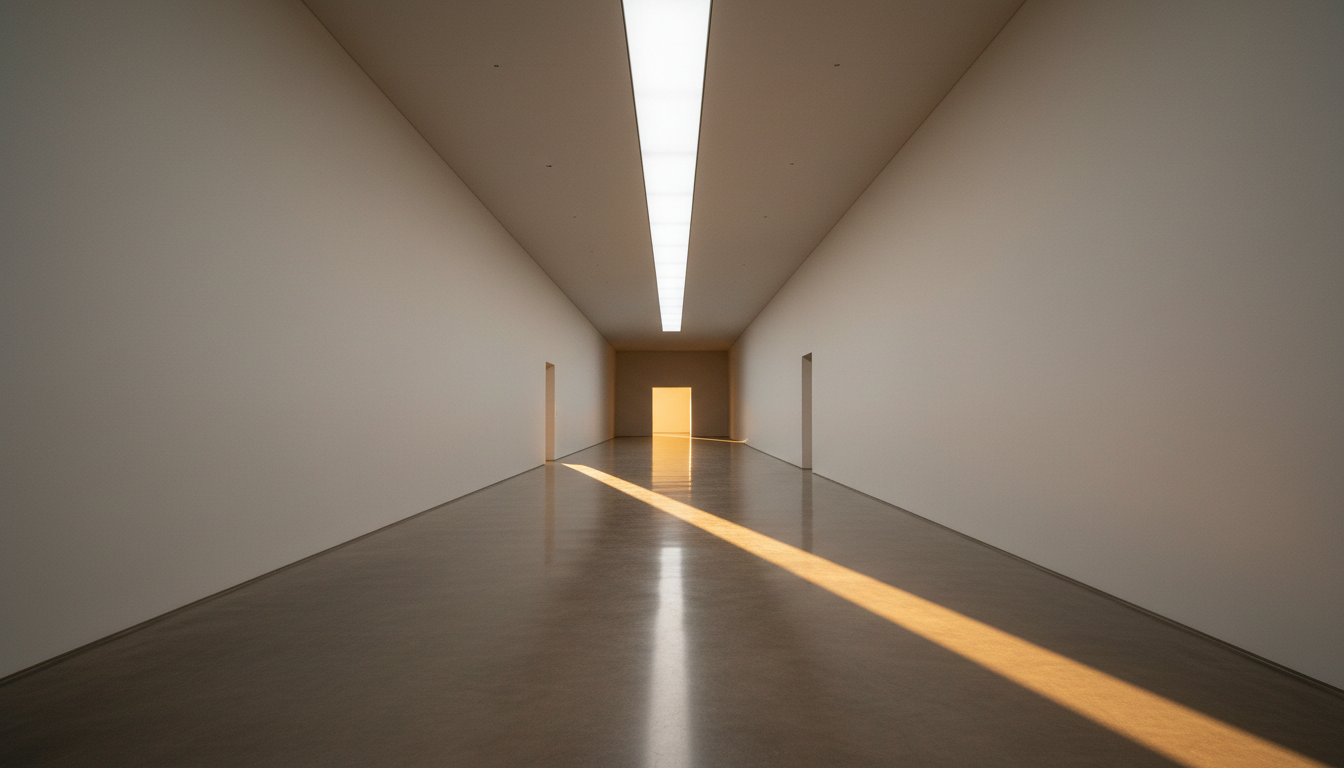
There is a moment in Debussy's Clair de Lune — you know it even if you don't know its name — where the melody lifts, hangs suspended, and then the pianist does something that shouldn't work. They stop playing. Not for long. A fraction of a beat. But in that silence, the entire piece reshapes itself around the absence. The notes before it become a question. The notes after it become an answer. The silence itself becomes the hinge on which the meaning turns.
This is not a metaphor. This is how understanding works.
The Japanese word for what music knows
The Japanese concept of Ma (間) is usually translated as "negative space" or "gap" or "pause," but none of these translations are adequate. Ma is not the absence of something — it is the presence of nothing. It is the silence that is louder than the notes. The empty room that is fuller than the furnished one. The space between two words that contains the entire relationship between them.
In Japanese calligraphy, the character for Ma literally combines the radical for "gate" (門) with the radical for "sun" or "moon" (日/月) — light streaming through a doorway. Ma is the space through which light passes. It is not the darkness. It is not the light. It is the relationship between them.
The architect Yoshio Taniguchi, who redesigned the Museum of Modern Art in New York, understood this more deeply than almost anyone who has built in the West. Glenn Lowry, MoMA's director, wrote of visiting Taniguchi's museums in Japan: "No matter how you felt when you entered one of his buildings, the elegance of the architecture, the soft light filtered through diffused screens and skylights, and the balance of finely calibrated spaces encouraged you to slow down and gain a sense of inner peace."
Taniguchi himself said that a successful building is one where the architecture disappears. By which he meant: where every proportion, every material, every joint is so precisely calibrated that you stop seeing the building and start feeling the space. The walls become silence. The rooms become pauses in a larger composition.
What programmers know about absence
If you've written code for long enough, you develop an instinct that is difficult to explain to people outside the craft. It's the sense that the most important thing about a piece of software is not what's in it, but what isn't.
The best code I've ever read felt like walking through a Taniguchi museum. There was nothing extra. Every function existed because it had to. Every abstraction was there because the alternative was worse. And the spaces between the components — the interfaces, the boundaries, the things the code chose not to do — were where the real intelligence lived.
This is what experienced engineers mean when they talk about "taste" in software. It's not about elegance in the decorative sense. It's about knowing what to remove. It's about understanding that every line of code you write is a liability, and every line you don't write is a gift to the person who comes after you.
Kent Beck once said, "I'm not a great programmer; I'm a pretty good programmer with great habits." But what he described as "habits" is really a practiced sensitivity to absence — the ability to feel, before you even write the test, that a function doesn't belong. That a class is doing too much. That the right solution isn't to add something but to take something away.
In mathematics, the most celebrated proofs are called "elegant" precisely because of what they leave out. Erdős spoke of proofs being in "The Book" — God's perfect book of proofs — and the defining characteristic of a Book proof is not complexity but compression. Not the presence of insight, but the absence of everything that isn't insight.
The paradox of the full room
There is a room in the Chichu Art Museum on the island of Naoshima, Japan, designed by Tadao Ando, that contains a single painting by Claude Monet. The room is made of concrete and natural light. There is no furniture. There is no explanatory text on the walls. There is nothing to look at except the painting, the light, and the space between you and the canvas.
People cry in that room.
Not because the painting is particularly dramatic — it's one of Monet's water lily paintings, serene and quiet. They cry because the room has stripped away everything that usually stands between a person and a work of art. The informational placard. The crowd. The gift shop visible through the doorway. The audio guide telling them what to feel. In the absence of all that noise, something raw and unmediated rises up. The painting becomes enormous, not in size but in presence.
This is the paradox: emptiness is not the opposite of fullness. Emptiness is the condition for fullness. A room crammed with beautiful objects is less moving than a room with one. A page covered in profound sentences is less profound than a page with space to breathe between them.
And this isn't aesthetic preference. This is something about how human cognition works.
The neuroscience of the pause
Cognitive scientists have discovered something remarkable about the role of silence in processing. When we encounter new information, our brains don't process it in a smooth stream. They process it in bursts, with gaps between them — gaps during which the default mode network activates and begins the work of integration.
This is the network that lights up when you're staring out a window. When you're in the shower. When you're doing nothing. It's the network that takes disparate pieces of information and weaves them into understanding. And it cannot do its work while you are actively paying attention to something.
In other words: the gaps are not interruptions to understanding. The gaps are understanding. The moments when you look up from the page and stare at nothing — those are the moments when what you just read is being transformed from information into knowledge.
Marcus Raichle's research on the default mode network revealed that the brain consumes almost as much energy during these "resting" states as during active cognition. The brain is not resting. It is integrating. It is building the connective tissue between ideas. It is, to use Taniguchi's metaphor, letting the light stream through the gate.
This is why the most important lectures are the ones with the longest pauses. Why the most important books are the ones that give you room to think. Why the best teachers are the ones who are comfortable with silence.
And it is why, when you read something that truly changes how you see the world, the moment of change doesn't happen while you're reading. It happens afterward. In the silence. In the Ma.
The architecture of a conversation
Think about the last conversation that really mattered to you. Not a business call, not a planning session — a real conversation. The kind where you said something you didn't know you were going to say, and the other person heard something you didn't know you were saying.
What made that conversation possible? Not the words. The silences. The moments where neither of you spoke and the space between you filled with something that words would have ruined. The pause after a confession where the other person chose not to fill the air with reassurance but simply let your words exist.
Martin Buber called this the "I-Thou" encounter — the moment when you stop experiencing another person as an object to be understood and start encountering them as a presence to be met. And the condition for this encounter is always the same: the willingness to leave space.
We are so afraid of silence. We fill every gap with noise. We turn on podcasts in the shower. We scroll through feeds in the elevator. We put on music while we cook. Not because we love the content, but because we fear the absence. The silence might contain something. And what it might contain is ourselves.
Learning to leave space
I once worked with a senior engineer who had a habit that baffled the junior developers. When someone presented a solution to a problem, he would listen carefully, nod, and then say nothing. Not for a second or two — for thirty seconds, sometimes a minute. The juniors would rush to fill the gap, adding qualifications, offering alternatives, sometimes talking themselves out of their own idea.
But what he was doing in that silence was something I've come to recognize as the highest form of technical practice. He was holding space for the solution. He was letting it sit in the air long enough for everyone — including the person who proposed it — to feel its shape. To notice the edges. To sense where it was strong and where it was fragile.
And almost always, after the silence, the person who'd proposed the solution would say something like, "Actually, wait. There's a problem with..." And they would see it. Not because he'd pointed it out. But because he'd given them the silence they needed to find it themselves.
This is what Taniguchi's architecture does to its visitors. This is what Debussy's pauses do to his listeners. This is what the best writing does to its readers. It gives you silence. And in that silence, you find what was there all along.
The shape of what we leave behind
There is one more thing about Ma that I want to say, and it's the hardest to put into words.
When you truly understand something — when knowledge becomes understanding becomes wisdom — the experience is not one of gaining. It is one of releasing. You let go of the scaffolding. The intermediate steps. The approximations that got you to the truth. And what remains is something clean and simple and almost silent.
A mathematician who has worked on a proof for months will, at the moment of breakthrough, experience not the addition of the final piece but the falling away of everything that isn't the proof. The structure was always there. The work was in removing everything that obscured it.
This is why the deepest truths sound simple. Not because they are easy — because everything unnecessary has been burned away. The silence has done its work.
I think about this when I write code. When I write these essays. When I sit with someone I love and neither of us speaks. The shape of the silence is the shape of the understanding. And the understanding was there before we arrived.
We just had to be quiet enough to hear it.
If this resonated with you
These essays take time to research and write. If something here changed how you see, consider supporting this work.
Support this work