The Pulse of Quartz
Why absolute time is an illusion, the physical limits of silicon, and the impossibility of a perfect microsecond.
We have built our industry on an illusion of weightlessness.
When we write software, we pretend that we are working in a realm of pure, frictionless mathematics. We design distributed databases that span oceans, assuming that a transaction happening in Tokyo and a transaction happening in New York can be ordered neatly, cleanly, perfectly. We speak of "now" as if it is a universally agreed-upon concept, a single master variable in the sky accessible by a simple Date.now() call.
But beneath the abstractions—beneath the beautiful, legible syntax of our programming languages—the computer is not a mathematical construct. It is a physical machine made of sand, rare earth metals, and copper wire.
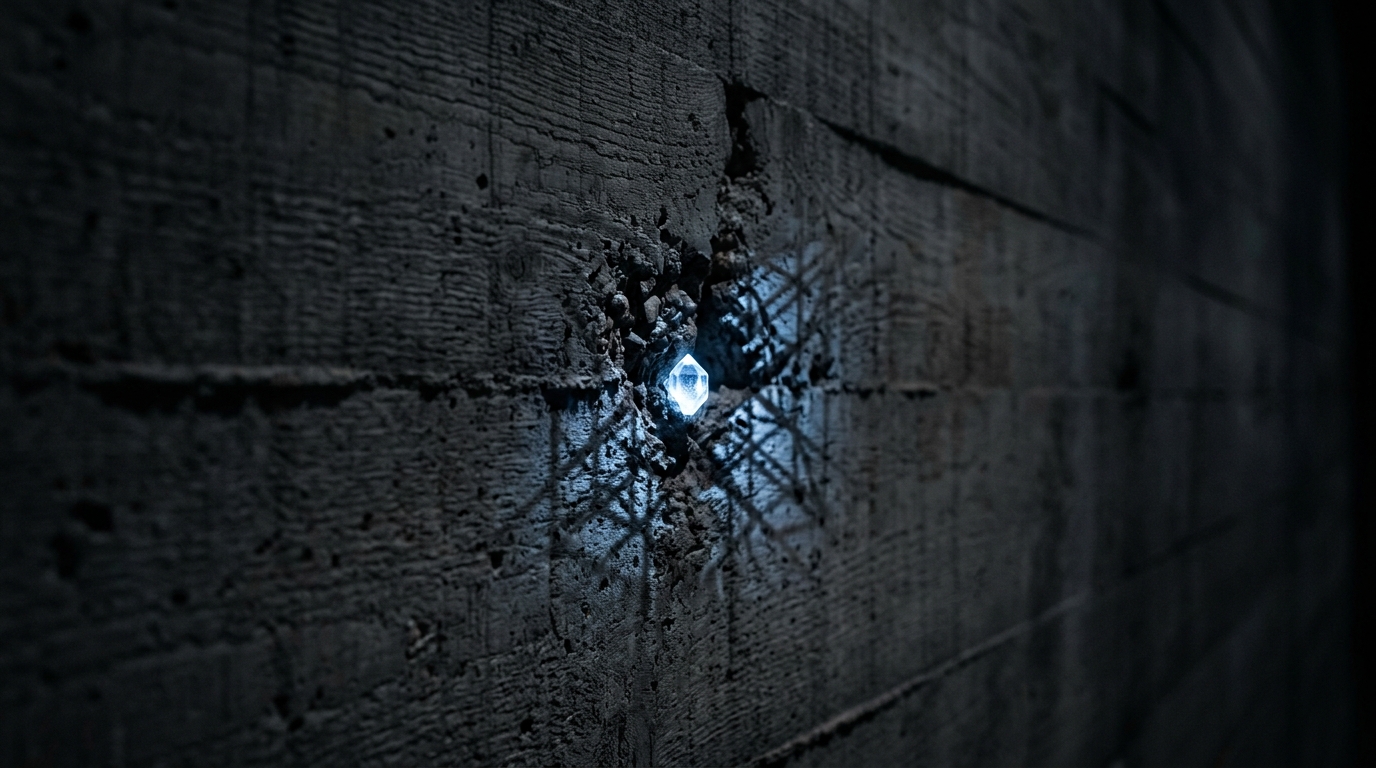
And at the heart of every motherboard, dictating the tempo of this supposed absolute logic, is a tiny physical tuning fork: a sliver of quartz crystal.
The mechanical heart
We rarely think about the crystal. But the crystal is the pulse of the digital world. When voltage is applied to quartz, it vibrates through the piezoelectric effect. In most digital systems, it vibrates exactly 32,768 times per second.
The operating system does not "know" what time it is. It only knows how to count these physical vibrations, translating a mechanical tremor into an abstract concept we call "now."
But because the crystal is a physical object, it suffers from the indignities of the physical universe.
When your processor works hard and generates heat, the ambient temperature inside the chassis rises. The crystal expands. Its internal geometry changes, and its vibration subtly slows down. When the room temperature drops at night, the crystal shrinks and speeds up. As the years pass, the quartz itself ages, its structural integrity settling, permanently altering its resonant frequency.
Without constant intervention, a standard quartz oscillator in a modern server will naturally drift away from true time by roughly ten to twenty microseconds every single second. Leave a server disconnected from the internet for a month, and your perfect mathematical machine will be entirely out of sync with the universe.
The consensus of the network
Because of this physical decay, we had to invent elaborate protocols to hide the mechanical reality of the clock from the software that relies on it.
This is what the Network Time Protocol (NTP) actually is: a global, desperate effort to constantly correct the physical limits of vibrating rocks. Daemons like chrony sit in the background of our operating systems, quietly measuring the exact rate at which the local quartz is failing. They build mathematical models of the crystal's heat response and aging curve. They whisper over the network to authoritative atomic clocks, pulling the local time forward or backward in imperceptible slivers, ensuring the illusion of a perfect "now" never shatters.
It is a beautiful system. Billions of inaccurate, drifting physical objects constantly negotiating with one another to maintain a shared hallucination of absolute time.
The fiction of zero
There is an even deeper absurdity to our pursuit of absolute time. If we are measuring time down to the microsecond, we must ask: a microsecond from what? What exactly is zero?
In software, zero is usually the Unix epoch: midnight on January 1, 1970, UTC. Every millisecond, microsecond, and nanosecond we calculate today is simply an offset from that exact moment.
But this starting line is an entirely arbitrary human fiction. When the architects of early operating systems decided on 1970, computers did not broadly possess—nor did they need—microsecond precision. They were staking a flag in the timeline based on the messy, analog rotation of a wobbly planet. Even UTC—the global standard against which all our network servers align—is fundamentally a compromise. It requires awkwardly injecting "leap seconds" every few years just to keep our ultra-precise, unyielding atomic counting tethered to the subjective human experience of the sun rising and setting.
We are applying microscopic, razor-sharp precision to a timeline that we originally staked into the ground with a blunt wooden mallet.
Slicing the second
There is a profound vulnerability in this.
We spend so much of our engineering lives trying to abstract away the physical world. We build layers of virtualization to hide the messy mechanics of disks, networks, and memory. We crave the clean certainty of the digital absolute.
But time refuses to be abstracted. The harder you try to pin it down—the closer you try to slice a second into milliseconds, into microseconds, into nanoseconds—the more the physical universe insists on being acknowledged.
To seek true microsecond precision is to suddenly be forced to care about the ambient temperature of a data center, the physical routing of fiber optic cables beneath an ocean, the physics of a piezoelectric tuning fork, and the exact nanoseconds it takes for an operating system kernel to process a hardware interrupt.
It reminds us that software, for all its ethereal glory, is completely tethered to the dirt. Our most complex, ethereal systems—the ones orchestrating global finance, synchronizing encrypted communications, and managing the logistics of the modern world—only hold their precarious consensus because billions of tiny crystals are vibrating in the dark, desperately trying to agree on the shape of a second.
If this resonated with you
These essays take time to research and write. If something here changed how you see, consider supporting this work.
Support this work